



D-STAR in one place
D-Star Statistic is an independent project for monitoring and visualizing activity on the D-STAR digital amateur-radio network. Its goal is to bring information about repeaters, hotspots, and current station activity from different countries together in one clear interface. The project was created for radio amateurs who want to quickly check what is currently happening on the D-STAR network—without searching through multiple independent sources and systems.
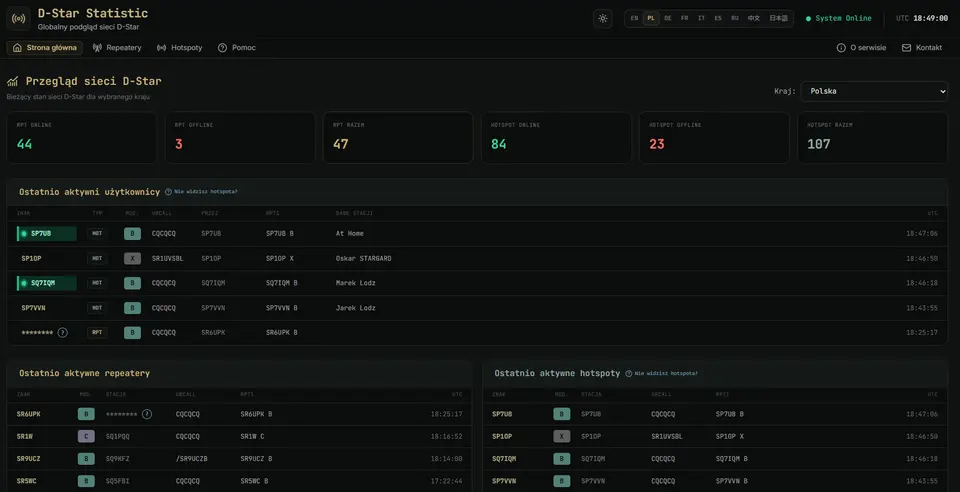
The dashboard presents a current view of the D-STAR infrastructure in the clearest form possible. Data is organized by country, allowing users to monitor both repeaters and hotspots participating in the network. The service provides their status, the time of their last recorded activity, supported modules, and information about stations appearing in network traffic. This allows D-Star Statistic to serve both as a quick view of current activity and as a tool for better understanding how the international D-STAR infrastructure operates.
Repeaters and hotspots
One of the project's fundamental principles is to present repeaters and hotspots within one consistent system. For available devices, the service may display, among other details, ONLINE/OFFLINE status, callsign, module, the time of the last activity in UTC, station information, URCALL, connection data, and other parameters available in the source D-STAR traffic. The scope of information depends on what data is actually available for the specific device and protocol.
Data from the real network
D-Star Statistic uses operational data sources related to the D-STAR network, including ircDDB, ircDDB Live, and OpenQuad. Information is retrieved and processed by the project's collectors and then passed to the dashboard interface. An important project principle is to preserve the source data as faithfully as possible. The service does not invent missing information or present estimated values as real data. If a particular parameter cannot be reliably confirmed from the source, it is not presented as fact.
LIVE, TX, and BER
Parameters related to the current transmission, such as LIVE, TX, or BER, appear only when the source being used provides information that allows them to be interpreted unambiguously. D-Star Statistic does not generate artificial values simply to fill the interface. The project's priority is the reliability of the information presented, even if this means that less data is available in some areas.
Real-time updates
The interface is updated regularly through the project's collector APIs. When the page is first opened and when the selected country is changed, the dashboard uses a complete data snapshot, so users should not receive a partially loaded dataset as the current state of the network. The goal is to create the experience of a real D-STAR monitoring center—fast, clear, and focused on current activity.
A global view of D-STAR
The project was designed for data from many countries. Selecting a country makes it possible to quickly navigate to the area of interest and view its repeaters, hotspots, and activity. The flag and counter system makes it easier to understand the available data and quickly switch between different regions of the world. As a result, the dashboard is not limited to local infrastructure—it presents D-STAR as an international network created by radio amateurs.
Clarity first
D-Star Statistic is being developed as a technical tool, but its interface has been designed so that the most important information can be read without lengthy analysis of tables and logs. Device status, activity, time, callsigns, and connection information are presented consistently, while search makes it possible to quickly find a particular repeater, hotspot, or station. The project is developed primarily from the perspective of practical use by operators.
How should device status be interpreted?
The ONLINE/OFFLINE status displayed on the dashboard is based on information available from network sources and the rules used by D-Star Statistic collectors. The absence of a device from the data, or an OFFLINE status, does not necessarily indicate a physical failure of the repeater or hotspot. The displayed status may be affected by network delays, temporary source unavailability, routing changes, or incomplete data on the external systems' side. The dashboard therefore shows the current view visible from the perspective of the connected data sources.
Project developed as a BETA
D-Star Statistic remains a BETA project. The service is operational, but the way data is interpreted, support for individual protocols, the collectors, and the interface itself are still being developed. New features are introduced primarily when the meaning of the source data can be confirmed and it can be ensured that the information presented to users corresponds to the actual state observed on the network. The project will be gradually expanded as the infrastructure develops and additional reliable data sources become available.
A project for the amateur-radio community
D-Star Statistic was created out of an interest in digital amateur-radio communication technology and the need for one convenient place to monitor the D-STAR network. It is a technical project developed for operators, infrastructure administrators, and everyone interested in how the digital amateur-radio network works and evolves. One dashboard. Many countries. Repeaters, hotspots, and live D-STAR activity.
Important information
D-Star Statistic is an informational and technical tool intended for the amateur-radio community. The information presented by the service depends on the availability and timeliness of external data sources and should not be treated as a guarantee of infrastructure availability.
The service is not intended for emergency use, public safety applications, or as an official source of regulatory information.
D-STAR, product names, system names, and network names remain the property of their respective owners.