



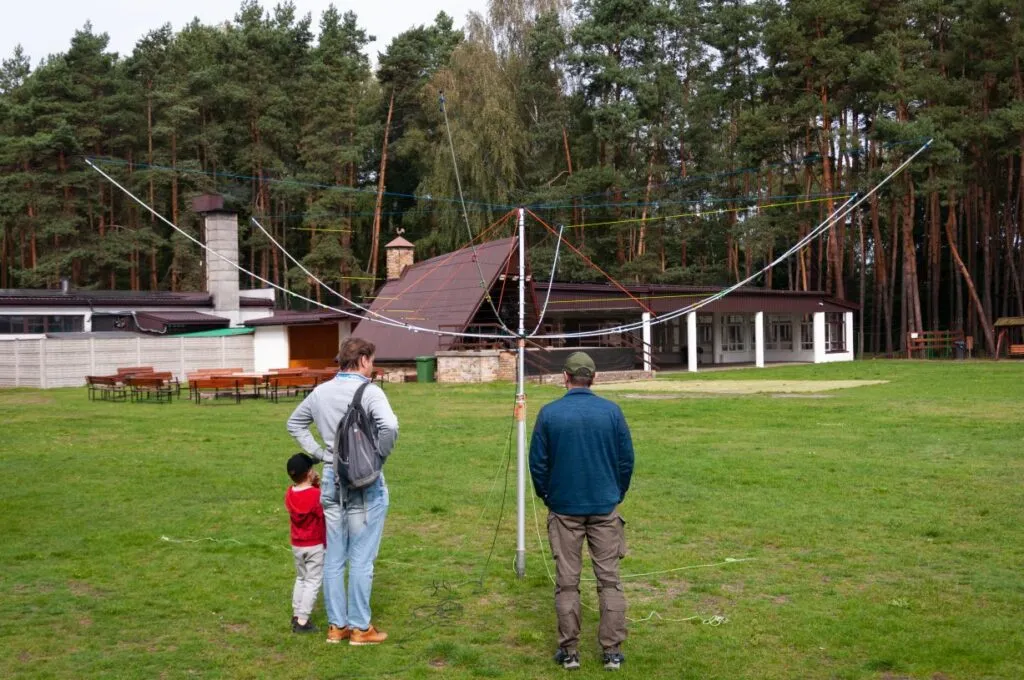
The Burzenin event has gone beyond the format of a conventional amateur-radio rally for many years. The organisers emphasise that it is a place for constructors at various levels of experience – both those designing their own equipment and those building from available documentation or ready-made kits. Lectures, demonstrations, workshops, the opportunity to discuss participants’ own projects and the competition PUK – Useful Amateur Radio Device.
From antennas to analysers and interference
This year’s Convention featured an extensive programme running in parallel in several rooms, as well as outdoors and in the field. On Friday, participants could already attend talks including one by Krzysztof SP7WME, who spoke about simple and effective antenna solutions, and Władysław SP9GNM who presented practical experience with the construction of Cubical Quad antennas. The programme also included spectrum-analyser measurements conducted by Wojciech SQ3BKI.
A report by Antoni SQ8AZT, representing the Puławska Amateur Radio Group, confirms the practical nature of these gatherings. The antenna presentation covered solutions for HF and VHF, while the lecture on Cubical Quads also showed elements of actual constructions and discussed experience gained during their construction.
Saturday brought an even greater concentration of topics. The programme included, among other things, interference affecting navigation systems, RF PCB design in KiCad, EMI/EMC issues, working with a VNA, the use of ferrites in RF installations, the fundamentals of VHF operation, SOTA, artificial intelligence in amateur-radio applications and precise frequency measurements as part of FMTLab.
Particular interest in the report SQ8AZT was generated by the presentation on interference affecting navigation signals. It covered jamming, spoofing and meaconing, as well as ways of identifying this type of interference. The programme also included a meeting with representatives of the Office of Electronic Communications, during which examples of unusual interference cases encountered in practice were presented.
Another technical highlight was radio-technology measurements using a VNA. Michał SP9XWM discussed the fundamentals and practical applications of antenna analysers and vector network analysers. According to a participant’s account, the presentation also included a practical measurement of a filter operating around 800 MHz.
PUK – projects created by amateur-radio operators
One of Burzenin’s most distinctive features remains the PUK – Useful Amateur Radio Device. Its aim is to promote the independent design and construction of electronic equipment used in amateur-radio practice, as well as self-education and teamwork. The rules cover, among other things, transmitters and receivers, antennas, test equipment, other functional blocks and software.
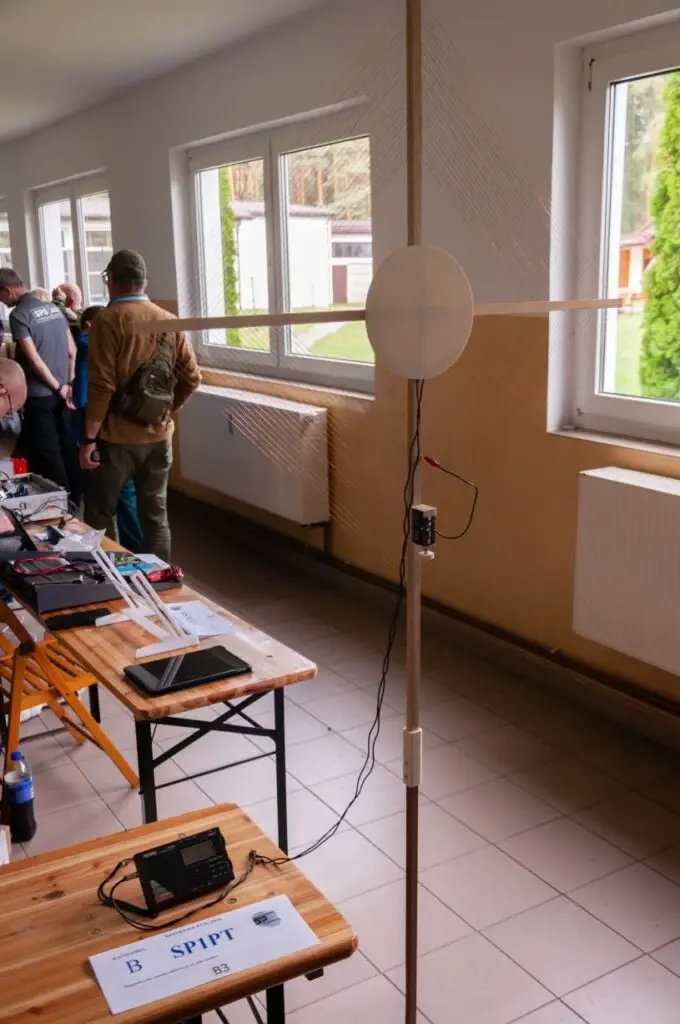
This year’s exhibition featured a wide variety of projects. Antoni SQ8AZT drew attention, among other things, to oil-cooled dummy loads designed by SP3SWJ and a large medium-wave receiving antenna built by SP1PT. The latter was a multi-turn loop on a wooden frame, equipped with a variable-capacitor tuning circuit.
The PUK exhibition aptly reflects the character of the entire Convention – the equipment on display is not limited to theory or visualisations. These are completed projects that can be viewed up close, while their authors are available for discussion and exchanging experience about the construction methods and solutions used.
Not just lectures
Burzenin also includes a field component. This year’s programme featured the first ARDF competition organised during the Convention, transmitter-building workshops for radio-orienteering and field „fox hunts” for children and adults. A separate workshop block was also prepared for the youngest participants.
On Saturday, there was also a several-hour swap meet, traditionally a place to look for parts, components and radio equipment.
Social activities were also an important part of the Convention. On both evenings, the organisers arranged gatherings under the shelter, while Saturday’s programme also included taking an official group photograph.
Burzenin remains a place for practical technology
The Technical Convention grew out of the QRP Workshops. The first editions were more intimate and focused on low-power operation. As interest grew, the format expanded to encompass the entire amateur-radio community and a much broader range of technology. Burzenin nevertheless remained primarily a place for building, experimenting and exchanging experience.
This year’s edition fits well into that tradition. Alongside classic antenna and measurement topics, there were sessions on PCB design, electromagnetic compatibility, satellite navigation systems, artificial intelligence and precise frequency measurements. The programme therefore covered both fundamentals useful to beginners and topics aimed at more advanced constructors.
An important element of the event remains the opportunity to meet directly with people working in specific areas of technology. It is precisely the combination of knowledge shared during lectures with the opportunity to see working projects, antennas and test instruments that forms one of Burzenin’s most distinctive features.
Official Convention website
Full Convention programme
Antoni’s photo report SQ8AZT